Hour One vs Digital Maker AI for Faceless YouTube Channels
By Alex Stevens
Hour One vs Digital Maker AI: the short answer
If you are comparing Hour One vs Digital Maker AI for running a faceless YouTube channel, Digital Maker AI is the clearer choice for solo creators, and the reason is simple: it is built end-to-end for YouTube, while Hour One was built for enterprise communications teams. There is also a more immediate practical point worth knowing before you go any further: Hour One was acquired by Wix in May 2025 and its platform has since been discontinued. The hourone.ai website now shows the message "HourOne Is No Longer Available." This article covers what Hour One was, what made the two tools different, and why Digital Maker AI is the stronger ongoing option for creators who want a complete faceless YouTube pipeline.
The criterion used throughout this comparison is suitability for a solo creator running a faceless YouTube channel: that means the ability to go from a topic idea to a finished, ready-to-upload video, affordably, without a team. Every section below applies that lens consistently.
What Hour One was
Hour One was an AI avatar video platform founded in 2019 and acquired by Wix on 23 May 2025. Before its shutdown, the company states it served enterprise departments including sales teams, product marketing, learning and development, and customer care. Its core product was a presenter-led video maker: you picked an AI avatar from a library, typed a script, and got a short talking-head video back. The platform was praised for realistic avatar quality and for cutting corporate video production time significantly.
That positioning shaped everything about the product. The workflow was designed around templates, brand kits, and team seats, not around a YouTube content calendar. There was no built-in script-to-scenes pipeline, no AI-generated scene images, no background music library aimed at YouTube, and no direct posting to YouTube, TikTok or Instagram. The platform produced short presenter videos rather than full long-form faceless content.
On pricing, Hour One offered a Free tier limited to 3 minutes of published video total, shareable by link only with no download. The Lite plan was $30 per month (as of its last active period before May 2025), giving 10 minutes of video per month. The Business plan was $112 per month for 20 minutes per month. An Enterprise tier used custom pricing. For a solo creator who needs a 10 to 20 minute YouTube video every week, those minute allowances were tight and the per-minute cost at Business tier was high.
Since the platform is no longer available, any creator who built their workflow on Hour One now needs an alternative. That is the practical starting point for this comparison.
What Digital Maker AI is
Digital Maker AI is a faceless video platform built specifically for YouTube creators. The core product is a long-form faceless video generator that takes a topic or a pasted script, writes the narration, generates a unique AI scene image for every scene, adds captions, and returns a finished MP4 ready to upload. That full pipeline, from blank page to finished video, is what makes it different from a standalone avatar tool.
The Video Maker screen shows the choice clearly: Short-Form Video or Long-Form Faceless Video, with the Animated Podcast and Drag and Drop Studio further down the page.
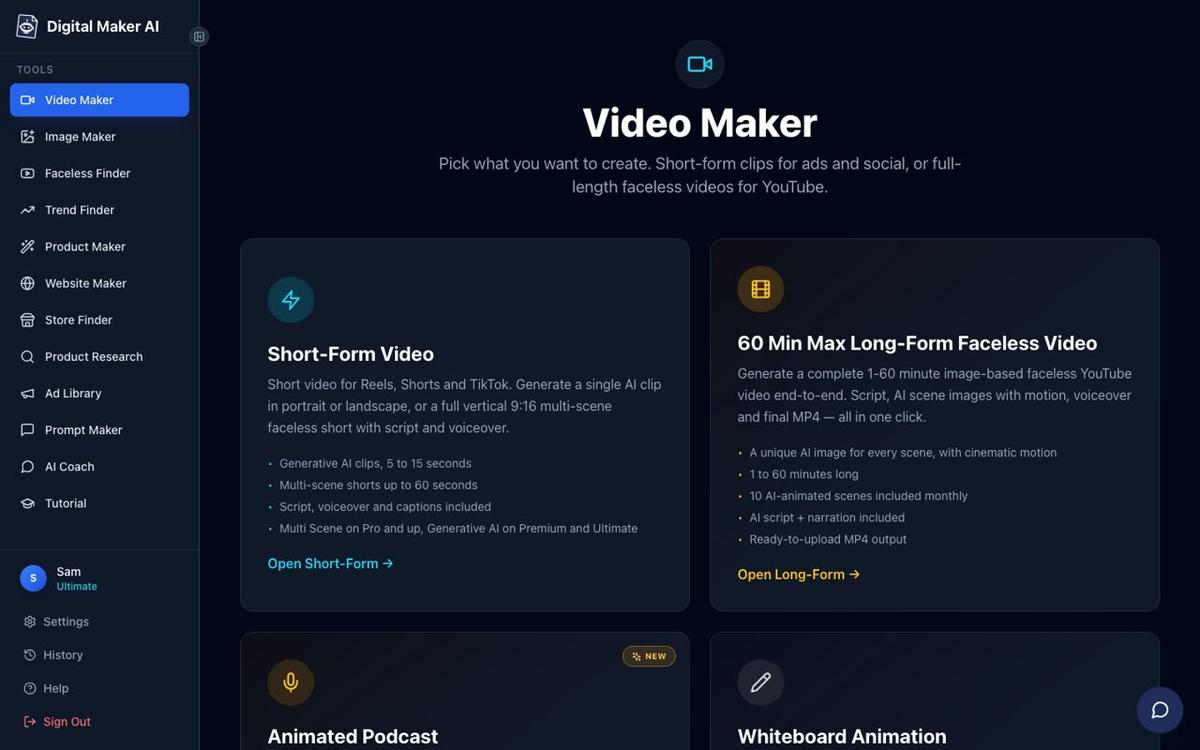
Long-form videos can run up to 60 minutes on the Ultimate plan, and the platform covers seven visual styles, six caption looks, and more than 100 built-in narration voices. Paid plans let you paste your own script on any topic rather than choosing from a preset list. After a video is made you can regenerate any scene image, swap in your own image or a short clip, or edit the narration text, though there is no timeline editor for manual trimming.
AI presenter quality and creation flow
This is the area where Hour One had genuine strength before its closure. The company built its reputation on hyper-realistic AI avatars drawn from a large library, with custom avatar creation available on higher tiers. For enterprise teams that needed a consistent branded presenter across hundreds of training videos, that was a real advantage.
Digital Maker AI's AI presenter feature takes a different approach, and it is fully launched as of October 2026. Rather than choosing from a library, you describe your presenter in a sentence or two inside Account Settings and the platform draws a photoreal image of them. You save that presenter and reuse them across videos. In the Video Maker you pick one of three layouts: Full screen (the presenter fills the frame), Split screen (presenter on the left, the scene on the right), or Corner circle (the scene with the presenter in a small round window). A slider controls how much of the video the presenter appears on screen, and markers on a timeline bar let you place them at the start, the middle, the end, or throughout.


Presenters are available on Premium and Ultimate plans and run on a separate avatar time allowance counted in seconds. Making a presenter uses 30 seconds. A video uses only the seconds the presenter is actually on screen. Premium starts with 2 minutes of avatar time and Ultimate with 5 minutes, with 3 additional minutes every month on Ultimate. Avatar Packs add more time as one-off purchases. Presenters work inside landscape Multi Scene long-form videos; they are not available on Shorts, Single Scene, Whiteboard or non-English videos.
Where Hour One's presenters were the whole product, Digital Maker AI's presenters are one layer inside a complete YouTube video. That is an honest difference: if you only want a presenter video and nothing else, Hour One's library approach was broader. But Hour One no longer exists as a standalone product, and for a YouTube creator who wants scenes, narration, captions, and an optional presenter all in one workflow, Digital Maker AI covers the full picture.
Long-form video output
Hour One did not produce a full faceless YouTube pipeline. Its output was presenter-led video built from templates, with no AI-generated scene images, no per-scene narration-to-image matching, and no YouTube-oriented format. The platform's minute caps (10 minutes per month on Lite, 20 on Business) were designed for short corporate clips, not weekly YouTube uploads.
Digital Maker AI's long-form output is built specifically for YouTube's 16:9 landscape format. A single video can be up to 10 minutes on Pro, 30 minutes on Premium, and 60 minutes on Ultimate. Each scene gets its own AI-generated still image held on screen while the narration plays, with optional slow zoom or pan motion effects and an optional film grain look. The platform also offers Whiteboard Animation (hand-drawn sketches that draw themselves on screen) and a Single Scene format with bold animated captions, both on Premium and Ultimate. You can also add animated scenes, which turn chosen still images into real moving AI clips, available as an add-on on Premium and Ultimate.
For a creator publishing once or twice a week, the monthly minute pool matters: 40 minutes on Pro, 150 on Premium, and 300 on Ultimate. That is enough for regular publishing without counting every second.
Pricing comparison
Hour One's pricing before its May 2025 shutdown started at $30 per month for the Lite plan (10 minutes of video per month) and $112 per month for the Business plan (20 minutes per month), with Enterprise on custom pricing. Those figures are provided for historical comparison only, as the platform is no longer available.
Digital Maker AI's current plans, as of October 2026, are listed at digitalmaker.ai/pricing: Pro at $29 per month, Premium at $59 per month, and Ultimate at $99 per month. Annual billing reduces those costs further. The Free plan requires no card and gives five real videos, one of each type, including one long-form video up to 8 minutes, one vertical Short, one animated podcast, one drag-and-drop video and one drag-and-drop movie.
The pricing gap is significant. At the price Hour One charged for its Business plan, a creator could run Digital Maker AI's Ultimate plan and still have money left over, with far more video minutes and a complete YouTube pipeline included.
Free access
Hour One offered a free tier that gave 3 minutes of total video creation, shareable by link only with no download option. That was enough to test the avatar quality but not enough to produce a real YouTube video.
Digital Maker AI's Free plan gives five complete videos with no credit card needed: one long-form faceless video up to 8 minutes, one vertical Short, one animated podcast, one drag-and-drop video from your own images, and one drag-and-drop movie from your own clips. Free videos carry a small watermark and are limited to English, Multi Scene format, two visual styles, and standard voices. Commercial usage rights are included on every plan including Free. You start from the Video Maker button in the left sidebar after signing in, pick the type, and press Next at the bottom of the screen.
That is a meaningful difference: with Digital Maker AI's Free plan you can produce and publish a real YouTube video before spending a single dollar.
YouTube posting and social publishing
Hour One had no direct YouTube posting feature. Videos were downloaded or shared via link, and uploading to YouTube was a manual step the user handled themselves.
Digital Maker AI's Premium and Ultimate plans include direct posting to YouTube, TikTok and Instagram from a Post to socials button, either immediately or on a schedule, after connecting the accounts once in Account Settings. Nothing posts automatically; it posts when you press Post, and posts are labelled as AI-generated. Free and Pro users download the MP4 and upload it themselves. More detail on the publishing workflow is at digitalmaker.ai/ai-video-auto-publishing.
Recommendations by use case
- Best for a solo faceless YouTube creator: Digital Maker AI, without question. The full pipeline from script to finished MP4, the range of video lengths, the presenter layouts, and the direct YouTube posting are all built for exactly this use case. Hour One no longer exists as a standalone product.
- Best for long-form YouTube videos (10 to 60 minutes): Digital Maker AI on Premium or Ultimate. Hour One never offered a comparable long-form faceless pipeline.
- Best for trying before buying: Digital Maker AI's Free plan gives five real videos with no card required, making it easy to judge the output quality before committing.
- Best for enterprise communications teams: Hour One was genuinely strong here before its acquisition. If your need is corporate training videos, HR communications or sales enablement with a branded presenter, the technology now lives inside Wix. For a dedicated standalone tool in that space, you would need to evaluate current alternatives such as Synthesia or Colossyan.
- Best on a budget: Digital Maker AI Pro at $29 per month (as of October 2026, see digitalmaker.ai/pricing) gives 40 minutes of video per month and up to 10 minutes per video. That is a workable YouTube publishing schedule at a fraction of what Hour One charged.
- Best for AI presenter videos on YouTube: Digital Maker AI's presenter feature on Premium or Ultimate, which puts a photoreal AI presenter inside a complete faceless video with scenes, narration and captions all in one output. See the AI avatar video generator page for more detail.
What Digital Maker AI does not do
Honest comparisons include limits, so here are the main ones. Digital Maker AI does not have a timeline editor with manual trimming and transitions. It does not include stock footage libraries or b-roll clips. AI presenters are not available on the Free or Pro plans, or on Shorts, Single Scene, Whiteboard or non-English videos. The animated scenes add-on and the Generative AI clip tool are the only places real moving footage is generated; the standard Multi Scene video uses AI-generated still images with optional pan and zoom, not moving animation. Voice cloning on the Animated Podcast requires your own ElevenLabs key. If any of those limits matter for your specific workflow, factor them in.
For more comparisons in this space, the Argil vs Digital Maker AI article covers another avatar-focused tool alongside the full pipeline question, and the Vyond vs Digital Maker AI comparison covers animation-led platforms.
Final verdict on Hour One vs Digital Maker AI
The Hour One vs Digital Maker AI comparison is now largely settled by circumstance: Hour One is no longer available as a standalone platform, having been acquired by Wix and discontinued in 2025. What it offered, high-quality enterprise avatar videos for corporate teams, was genuinely useful for that audience, but it was never designed for the solo creator who needs a complete faceless YouTube pipeline at an accessible price. Digital Maker AI is. From the Free plan that lets you publish a real video before spending anything, to the Ultimate plan that handles 60-minute videos and posts them straight to YouTube, the platform is built around exactly what a faceless channel needs. If you want to see what the output looks like before committing, start with the free course at Digital Maker AI, which walks you through the whole workflow step by step.
Alex Stevens: Alex Stevens writes for the Digital Maker AI team about faceless YouTube channels, AI presenters and AI video tools.